Quantitative Finance
Can momentum features improve stock direction prediction?
Abstract
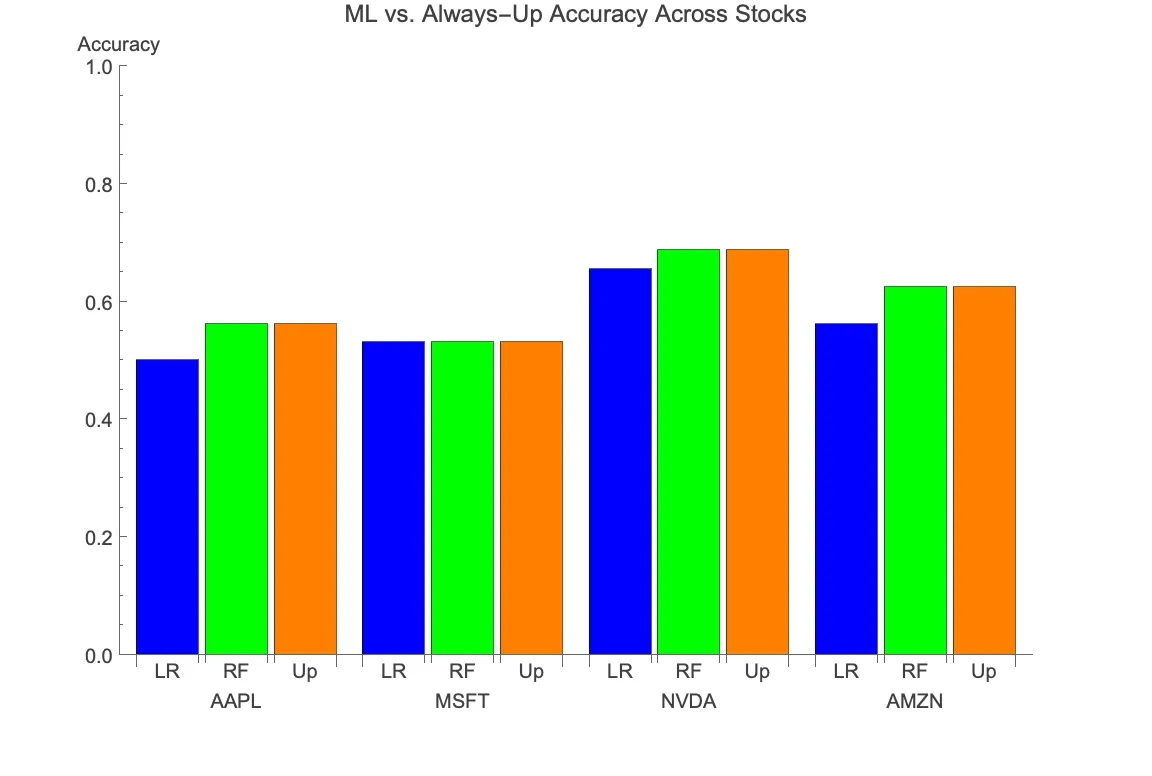
Stock prices are notoriously difficult to predict. While the Efficient Market Hypothesis suggests that future price movements should be largely unpredictable, momentum investing has remained one of the most persistent anomalies in financial markets. This essay investigates whether momentum-related features can improve stock direction prediction beyond a naive always-up benchmark. Using monthly data from four large-cap U.S. technology stocks (AAPL, MSFT, NVDA, and AMZN) between 2015 and 2024, the analysis constructs four momentum-based features: one-month return, three-month return, six-month return, and rolling volatility. Logistic regression and random forest classifiers are then trained to predict whether the next month’s return will be positive or negative. The models’ predictive performance is evaluated against two benchmarks: random guessing and a naive strategy that always predicts positive returns. Results show that while the classifiers occasionally perform slightly above random chance, they generally fail to outperform the always-up benchmark consistently. Random forest sometimes matches the benchmark, but neither model clearly exceeds it across the four stocks examined. These findings suggest that simple momentum and volatility features contain limited predictive information for monthly stock-direction forecasting, highlighting both the difficulty of financial prediction and the strong upward drift present in large-cap equity markets during the sample period.
Read the full essayPublished on Wolfram Community. Research and essay © the author.