Deep Learning
SARON: synthetic aperture radar oriented network
Abstract
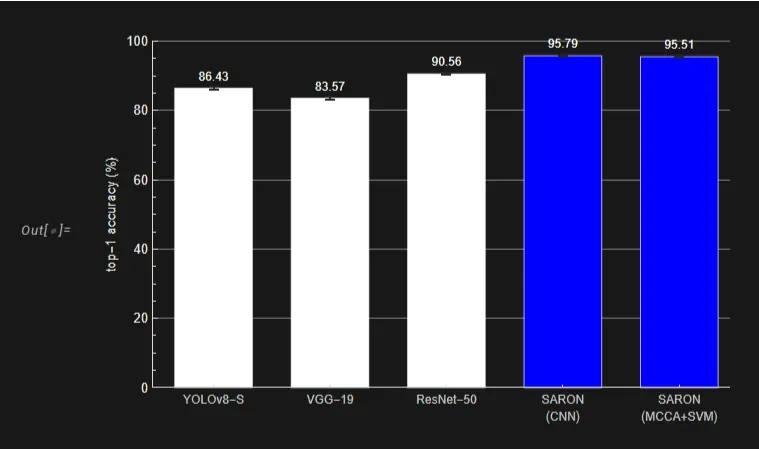
Synthetic Aperture Radar (SAR) automatic target recognition (ATR) is an important capability in remote sensing. However, SAR images’ distinctive speckle noise and low resolution characteristics make it hard to distinguish. Thus, it is a fair question whether general classification models trained on everyday photos are the right tool for SAR images.This work investigates whether a a SAR-oriented model proposed by Amrani et al., which connects a SAR-Oriented Network (SARON), Multi-Canonical Correlation Analysis (MCCA) feature fusion, and finally a linear Support Vector Machine (L2-SVM) classifier, provides a meaningful classification performance gain over other three well-known models- YOLOv8-cls, VGG-19, and ResNet-50.SARON is freshly trained upon ATRNet-STAR, one of the newest public SAR images dataset, while other models are fine-tuned on ATRNet-STAR.The SAR-specific network wins. SARON without feature fusion shows 94.05% top-1 accuracy, 93.66% for SARON with the full pipeline, 86.43% for YOLOv8-cls, 83.58% for VGG-19, and 90.56% for ResNet-50.Considering that SARON is based upon VGG-19 architecture and reaches superior performance, the design choices of SARON are suitable for SAR images. However, the paper’s feature fusion step lowers the performance. Adding MCCA and SVM drops 0.39%p of accuracy.
Read the full essayPublished on Wolfram Community. Research and essay © the author.